Infleqtion: The Full Stack Quantum Thesis
Quantum's Coming Faster Than Ever Before, Here's My Pick.

I have become a fairly loud Infleqtion advocate on X, and I want to actually explain the company, lay out my conviction, and help you build your own. The story is more complicated than betting on a futuristic technology with immense potential. Most people buying it right now do not really understand what they own, and that is the real problem. Anytime there is an extreme drawdown, they instantly sell, or get harsh on themselves for ever buying in. It is hard to hold through volatility when you do not understand what you are holding, and giving you that understanding is my goal today.
I have played this game before with IONQ 0.00%↑ . I bought in at $7 and watched it rise to $50, only to get cut in half by Jensen Huang’s comments, before it eventually climbed to fresh highs near $80. Many panicked and lost money because they never understood the company or the technology in the first place.
Almost every quantum company is a single bet on a fault tolerant computer arriving years from now, a long stretch of cash burn and crossed fingers until the science finally lands. Infleqtion is not that, and in my view it is one of the best set up for success. Everything below is me earning that claim. The government and competition sections are where the conviction lives.
Here’s what I’ll cover, in order:
Infleqtion and the neutral-atom modality
Areas of immediate quantum advantage
Why governments are the customer
China and the quantum cold war
The executive orders and what they mean
The $2 billion CHIPS Act program
Project Farseer
Forced buying and the Russell inclusion
The roadmap
What could break the thesis
Neutral Atom Superiority
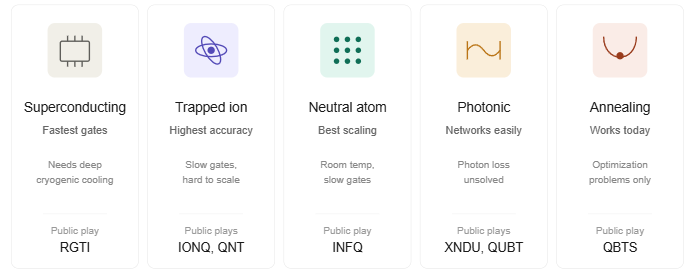
Every quantum computer runs on qubits, the quantum version of the 1s and 0s in a normal computer. There are several ways to build one, and each approach has its own tradeoffs. I will cover only a few.
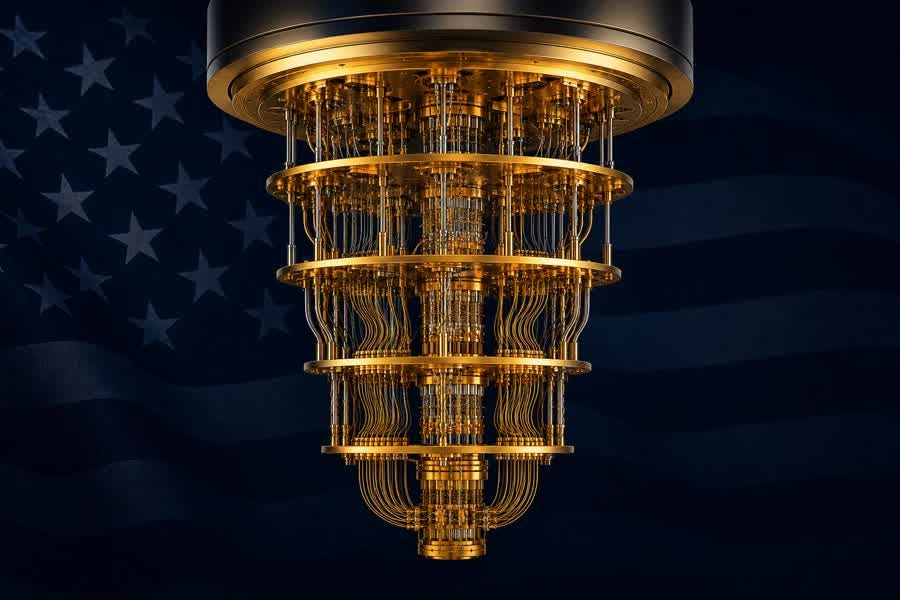
Superconducting is what IBM, Google, and Rigetti use. They print circuits onto a chip and chill it to nearly absolute zero, colder than outer space, using a refrigerator about the size of a chandelier. These qubits are fast, but they have two problems. They are locked in place, so each one can only really talk to the qubit next to it, and the wiring and extreme cooling get harder and messier the more qubits you add.
Trapped ion is what IonQ and Quantinuum use. They hold charged atoms in place with electromagnetic fields. This gives you the most accurate, highest quality qubits in the business, but you cannot fit many of them, and they run slowly.
Neutral atoms, which is what Infleqtion does, hold regular uncharged atoms in place using focused laser beams (the technical name is optical tweezers) and link them together to do the actual computing.
There are a few reasons I believe neutral atoms have real structural advantages.
First, every atom is perfect and identical, because nature makes them that way. You cannot manufacture an atom, so you never deal with the tiny flaws and inconsistencies that come with anything printed on a silicon chip. Every rubidium atom is exactly like every other rubidium atom. A built in head start.
Second, the hardware is structurally cheaper per qubit, and that gap compounds as you scale. A neutral atom system is built around lasers and a vacuum cell rather than a fabricated superconducting chip, and it avoids the expensive fabrication and cryogenic infrastructure that superconducting approaches require. When the whole game is adding more and more qubits, being cheaper per unit is a meaningful long term edge.
Third, you can physically move the atoms around in the middle of a calculation. With superconducting chips the connections are etched in permanently, so a qubit is stuck talking only to its neighbors. With neutral atoms, the layout is controlled by software, so you can bring any atom next to any other atom whenever you need to. No wasted steps, no built in bottleneck. This is exactly why neutral atom systems have been climbing the logical qubit leaderboard faster than anyone else.
Also, neutral atoms don’t need those giant, power hungry cryogenic refrigerators. Superconducting machines only work near absolute zero, so every system is wrapped in a massive cooling rig that is expensive to run, hard to maintain, and a nightmare to shrink. Neutral atom systems operate at essentially room temperature. The atoms themselves get cooled by lasers, but you are not chilling the whole machine in a chandelier sized fridge. That means a smaller footprint, lower operating costs, and a realistic path to deploying these systems outside a pristine lab. That matters a lot when your customers are the military and government agencies who want this working in the real world, not just on a lab bench.
You don’t have to take my word that this approach is promising. Google already runs arguably the best superconducting program on the planet, and it had already participated alongside SoftBank and other investors in a financing round of more than $230 million for a neutral atom startup called QuEra. Then it went and built its own second quantum program from scratch, this one focused on neutral atoms, at a new lab in Boulder.
Google’s decision doesn’t prove superconducting technology has hit its ceiling. Google itself publicly describes superconducting and neutral atom systems as complementary, with superconducting faster for certain tasks and neutral atoms scaling to more qubits and pairing better with the error correction methods the field is moving toward. But it’s a powerful external validation that neutral atoms have become strategically important enough for one of the world’s leading quantum programs to pursue directly.
Quantum is now?
Here is where Infleqtion stops being just a quantum computing company and separates from the rest.
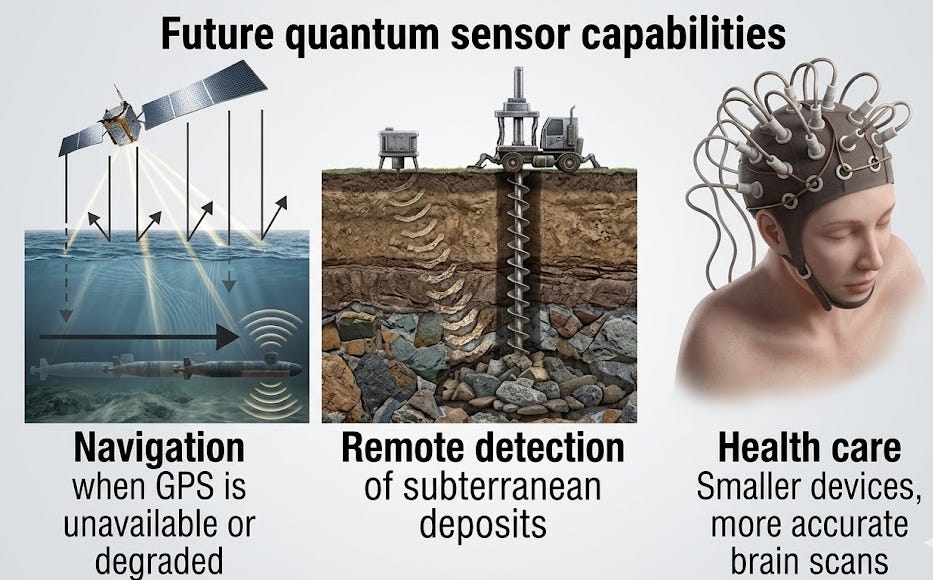
The same physics that runs the computing also makes spectacular sensors. If you can hold and measure atoms precisely enough to compute with them, you can also use them to measure time, gravity, and electromagnetic fields with a precision classical instruments cannot touch. Infleqtion has turned that into an actual product line selling today: optical atomic clocks it calls Tiqker, used by the Navy. Rydberg based RF receivers that pick up radio signals across an enormous bandwidth, and quantum gravity sensors and inertial navigation units for positioning when GPS is jammed or denied.
This isn’t vaporware either. On the Q1 2026 earnings call, the quantum gravity gradiometer was called out as the single largest individual revenue contributor in the quarter. The sensing business is the engine right now, anchored, in management’s own words, by national security use cases, with about 70% of revenue coming from the U.S.
The defense customer doesn’t need a fault tolerant computer in 2030 to write Infleqtion a check in 2026. They need a clock that keeps time when the GPS signal is gone, a gravimeter that lets a submarine navigate without surfacing or emitting anything, and an RF sensor that can hear what no one else can. Those things exist now, Infleqtion sells them now, and the buyer has a deep budget and a national security reason to spend it that has nothing to do with commercial adoption curves. That is the bridge that carries the company from here to the computer payoff without betting everything on a fault tolerant computers timeline.
Most quantum pure plays don’t have that bridge. They’re burning cash and praying the science arrives before the money does. Infleqtion has revenue, a strategic buyer, and a long runway, a different risk profile entirely.
The Government’s Favorite
Though my core belief is that the first real wave of quantum revenue comes from governments and militaries, not from pharma companies discovering drugs or banks optimizing portfolios. Those commercial use cases are real and enormous, but they come later. The government comes first because it can’t afford to be behind, and it has three things the commercial market doesn’t: a very deep budget, a national security reason to buy pre-commercial hardware, and a tolerance for paying for capability before it is cost effective. If you believe that, the question isn’t which quantum company has the best computer. It’s which company is best positioned with the government, and I think Infleqtion is that company. The relationships back this up.
Current customers and active programs
US Navy
UK Royal Navy clock trials, and engagements through the UK’s NQCC
Japan’s Moonshot R&D program, which selected Infleqtion’s platform (a direct foreign government revenue line)
A December 2024 DoD award (roughly $11M) for Tiqker optical clocks under the Rack Mounted Optical Clocks project
Research and technical collaborations
DARPA, the Department of Energy, ARPA-E, and the national labs (Sandia, Lawrence Berkeley, Fermilab, Argonne)
NASA collaborations, including a quantum gravity sensor in space
Contract vehicles and eligibility
Missile Defense Agency SHIELD IDIQ
Broader US Army and Department of War system engagements
Proposed or pending
The Department of Commerce CHIPS letter of intent (covered in detail below), which is not yet a finalized award
The Quantum Cold War


China has become the biggest competitive pressure on the U.S., and this is now a national security race. By most public estimates, Chinese government investment in quantum sits around $15 billion against roughly $4 billion in U.S. federal funding, the largest public sector quantum commitment of any nation by a wide margin. In March 2025, Beijing announced a national venture guidance fund worth about $138 billion across frontier technologies, with quantum named explicitly. China’s 15th Five-Year Plan, adopted in March 2026, named quantum the first of seven future industries designated as new engines of growth, ranking it alongside semiconductors and AI as official industrial policy.
The structure underneath that spending is the part worth paying attention to, because it’s the opposite of how the West does it. China consolidates quantum under the state. When Baidu stepped back from quantum in 2024, it “donated” its entire quantum lab and equipment to BAQIS, a Beijing state backed research institute. Alibaba did the same in 2023, “handing” its lab to Zhejiang University. In January 2025, China Telecom, a state owned enterprise, took controlling ownership of QuantumCTek, which runs the backbone of China’s national quantum secure communications network. The private champions fold into state institutions, which means the national effort sits in government hands. A quantum pure play company won’t go and hack another foreign government on its own, but a government possessing all of its quantum capabilities might. That’s a real structural advantage in a race that rewards centralized, patient, industrial scale funding, and it is exactly the model the U.S. is now scrambling to answer with equity stakes and executive orders.
Where China has pressed hardest is quantum communications, the satellite and metro QKD networks that protect its own traffic, an area where it is widely considered the global leader. The U.S. still leads in most quantum research and far outpaces China on private capital, roughly $3.7 billion in U.S. private quantum funding against a few hundred million in China, and retains a real edge in quantum sensing. Washington has moved to protect that lead with export controls since September 2024 on quantum computers and components, a ban on U.S. investment into China’s quantum sector, and an export blacklist that by March 2025 had swept in dozens of Chinese quantum firms including Origin Quantum, QuantumCTek, and USTC.
It’s also not just the U.S. and China. A bloc of allied governments has decided quantum is mission critical, and most are spending through onshoring and procurement programs that companies like Infleqtion can actually win.
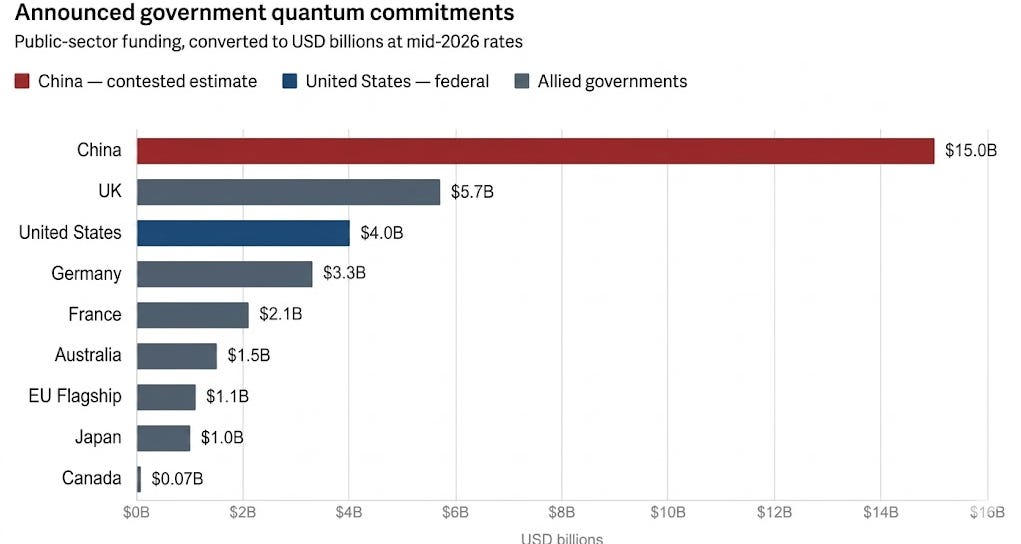
The UK runs a £2.5 billion National Quantum Strategy over ten years, and in March 2026 layered on an additional £2 billion specifically for quantum procurement and scaling, including a program called ProQure that invites companies to submit prototype development proposals, the same procurement led model that benefits established players. The UK is already an Infleqtion customer through the NQCC and the Royal Navy clock trials.
Japan declared 2025 the “first year of quantum industrialization,” and its Moonshot R&D program selected Infleqtion’s platform, a direct foreign-government revenue line.
Germany has earmarked around €3 billion, one of the largest single national commitments, and France is putting roughly €1.8 billion through its national strategy.
The EU’s Quantum Flagship is a €1 billion, decade long program coordinating quantum work across member states.
Canada launched its Quantum Champions Program in December 2025, up to $92 million with agreements as large as $23 million each, plus a February 2026 defense focused quantum R&D push.
Australia has committed somewhere north of AU$2.3 billion cumulatively, including a high profile billion dollar bet through its critical technologies fund.
Quantum is a priority now, not later and governments know they can’t be behind.
Quantum Urgency
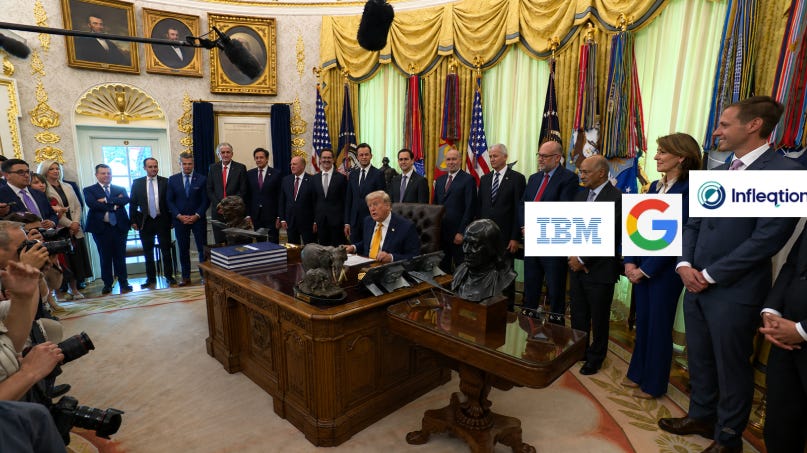
That pressure produced what came next. On Monday, June 22, 2026, Trump signed two executive orders on quantum in the Oval Office. Attending him was IBM CEO Arvind Krishna, Google President Ruth Porat, and Infleqtion CEO Matt Kinsella. A roughly $3 billion quantum company standing among two of the most influential tech companies in history.
The first order is the offensive one. It launches a national push to build the first research grade quantum computer capable of real scientific work, to be housed at a Department of Energy national lab and targeted for around 2028. It directs quantum sensors and networks to be deployed across the government within about five years. It pushes for onshoring the quantum supply chain, meaning lasers, photonics, vacuum cells, and packaging made domestically. Also expands the workforce and tightens counterintelligence around U.S. quantum IP.
The second order is defensive, and it’s about what people call Q-Day, the moment a quantum computer can break current encryption. It accelerates the federal migration to post quantum cryptography to 2031, pulled forward from a previous 2035 target, forces compliance with NIST’s new standards, and tasks CISA with hardening critical infrastructure like grids and banking.
The orders materially increase the probability of sustained federal procurement by turning quantum deployment into an explicit national priority with deadlines attached. They direct agencies to stand up programs and deployment plans against the 2028 and 2031 timelines. They don’t guarantee specific purchases, contract sizes, or awards to any one company, including Infleqtion, but they create a major and durable federal demand signal where there was ambiguity before.
The 2031 cryptography deadline also pulls forward a large enterprise migration wave. The federal migration and critical infrastructure push are real, and federal contractors will face growing pressure to go quantum safe to keep federal business. It is not an immediate blanket ultimatum on every private company, but the direction is unmistakable, and it is exactly the threat Infleqtion’s Shor’s algorithm demonstration was designed to make visceral.
Finally, the orders help re-rate part of the sector from speculative technology toward defense and infrastructure. That reclassification is precisely what a lot of institutional money was waiting for before it could touch the space.
Following The Money
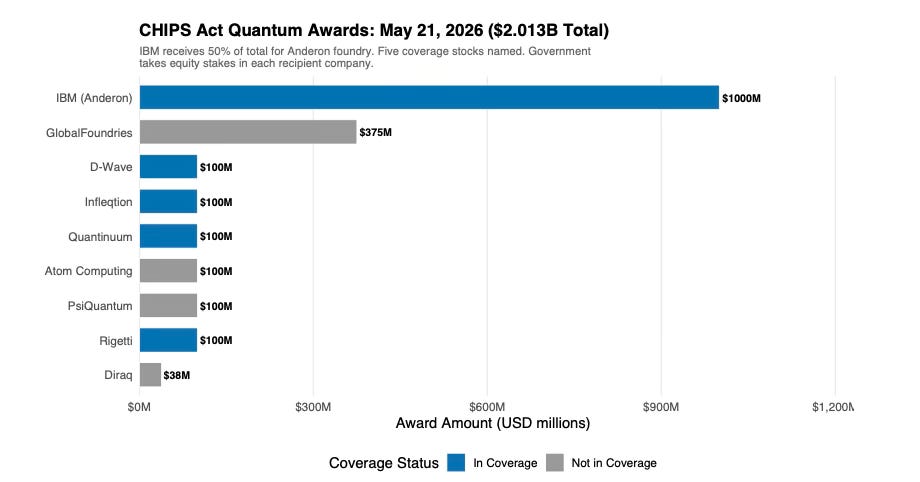
A little over a month ago, the administration announced approximately $2 billion in proposed quantum incentives through nine letters of intent under the CHIPS and Science Act, with the government to take equity stakes in return. The larger slices went to IBM at about $1 billion and GlobalFoundries at $375 million, with pure plays including D-Wave, Rigetti, and Infleqtion at $100 million each. This is announced and proposed, not yet fully transferred or finalized.
Infleqtion’s piece is a letter of intent signed May 21, 2026 with Commerce’s CHIPS R&D office: $100 million in proposed, milestone based funding for its neutral atom hardware, photonics, and full stack work, subject to diligence, final agreements, approvals, and performance milestones. It’s staged against milestones, not wired in a lump on day one. Management has said that money, together with related funding, would extend the company’s runway by nearly four years.
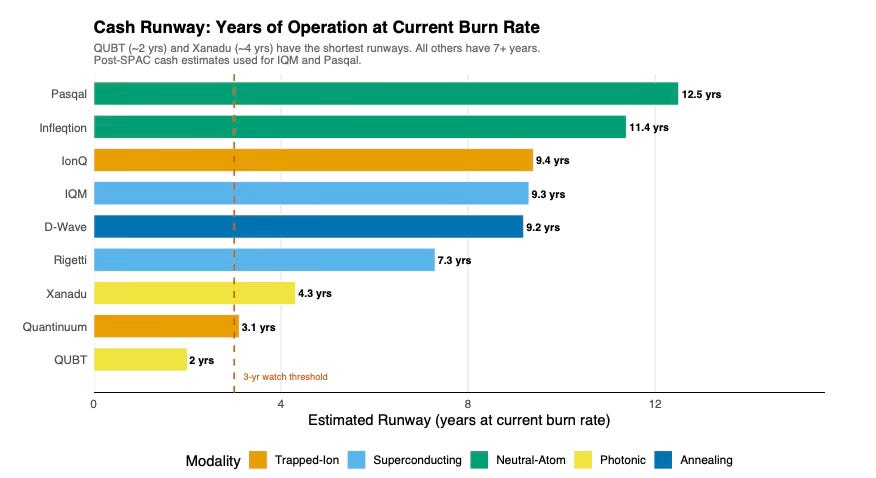
Despite how it might sound, the government taking equity reads to me as validation rather than a red flag. When people accuse this whole sector of being a scam, the cleanest rebuttal is that the U.S. government is proposing to take direct equity positions to underwrite these balance sheets. It also creates direct government access, which I believe is the most important thing you could have.
Project Farseer
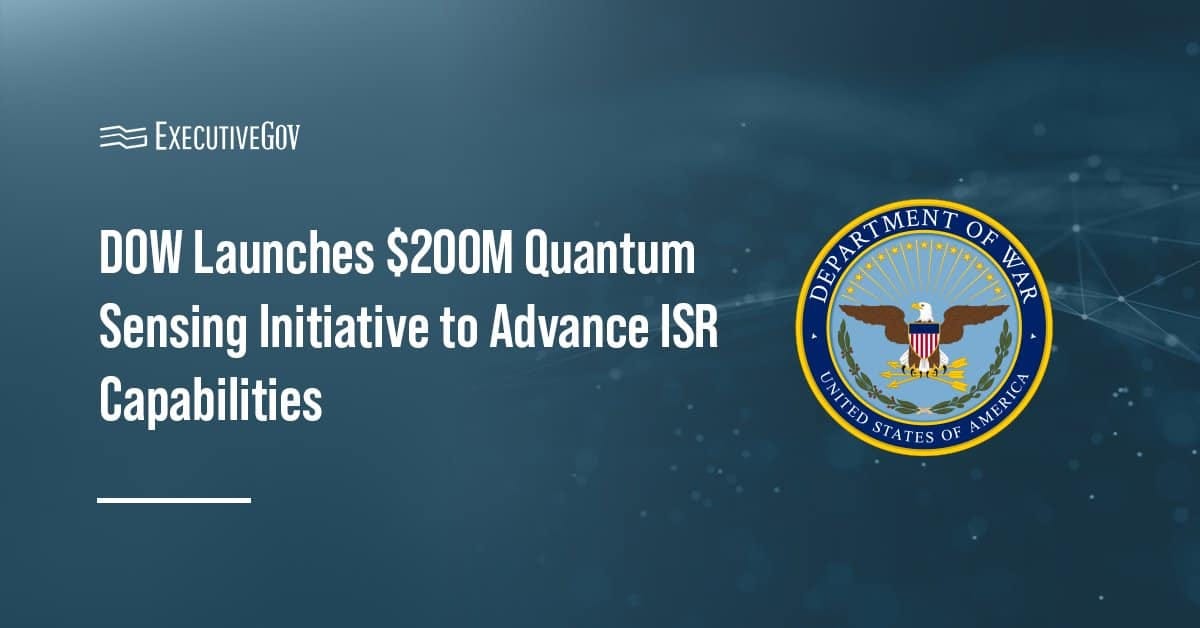
Remember that sensing and timing business already pulling in revenue? Here’s the government putting real money behind exactly that. A day after the executive orders, the Pentagon’s Defense Innovation Unit launched Project Farseer, and it points straight at Infleqtion’s wheelhouse. The program exists to take quantum sensing and timing technology that is already mature and rush it into operational military intelligence and reconnaissance use. DIU expects to invest up to $200 million over the next year across four buckets: magnetometers and electric field sensors, gravimeters for GPS denied navigation, portable atomic clocks, and the component technologies underneath them all.
Set that list against Infleqtion’s product line: Rydberg RF and magnetic sensors, a quantum gravity gradiometer that is already the company’s largest revenue contributor, and atomic clocks where Infleqtion is an established incumbent. It won that roughly $11 million DoD award in December 2024 for its Tiqker optical clocks, had its clock used by the Royal Navy aboard HMS Prince of Wales, and through its legacy business built portable atomic clocks for the Office of Naval Research. Farseer demands prototypes that can be demonstrated in an operational environment within three to nine months of award, a bar that screens out almost everyone, and Infleqtion is one of the few names that could plausibly meet it with hardware already in the field.
To size what this could be worth, it helps to understand how DIU pays. Awards run as Other Transaction agreements, and the prototype checks themselves are modest, typically a few million dollars each, spread across the four lines to seed a domestic supply base rather than crown a single winner. The headline $200 million is a ceiling across the whole program and all participants. So the prototype phase, for Infleqtion, is best understood in three scenarios.
Conservative. Infleqtion wins the clock line, where its incumbency makes it a strong favorite, and the prototype work lands a few million dollars in program value, billed against milestones across 2026 and 2027.
Base case. It wins clocks and takes a second line in gravimeters or magnetometers, where its gravity gradiometer and Rydberg sensing are competitive, carrying low to mid double digit millions in total program value across the two years.
Bull case. It wins clocks decisively and places across the sensing lines as both prime and teaming partner, pushing program value toward the high double digit millions and establishing Infleqtion as a default quantum timing and sensing supplier across the program.
Even the bull case for the prototype phase is a guidance supporting bump rather than a re-rating, and that is the point most commentary misses, because the prototype is not where the money is. Buried in the solicitation is a clause citing 10 U.S.C. section 4022(f). Complete a prototype successfully, and DIU can award a follow on production contract without a new competition. That is the part almost no one is talking about. The prototype is a few million dollars and a tryout, but a successful one could make Infleqtion eligible for a follow on production award without further competition, creating a path from a relatively modest prototype contract into a much larger multi year production opportunity that can bring in serious money.
Connect the dots, quantum executive orders, Kinsella standing among giants with Trump, Infleqtion’s leadership in timing and sensing, and then $200 million committed to exactly that space a day later. I am speculating that meaningful money could flow into Infleqtion here soon.
The Roadmap
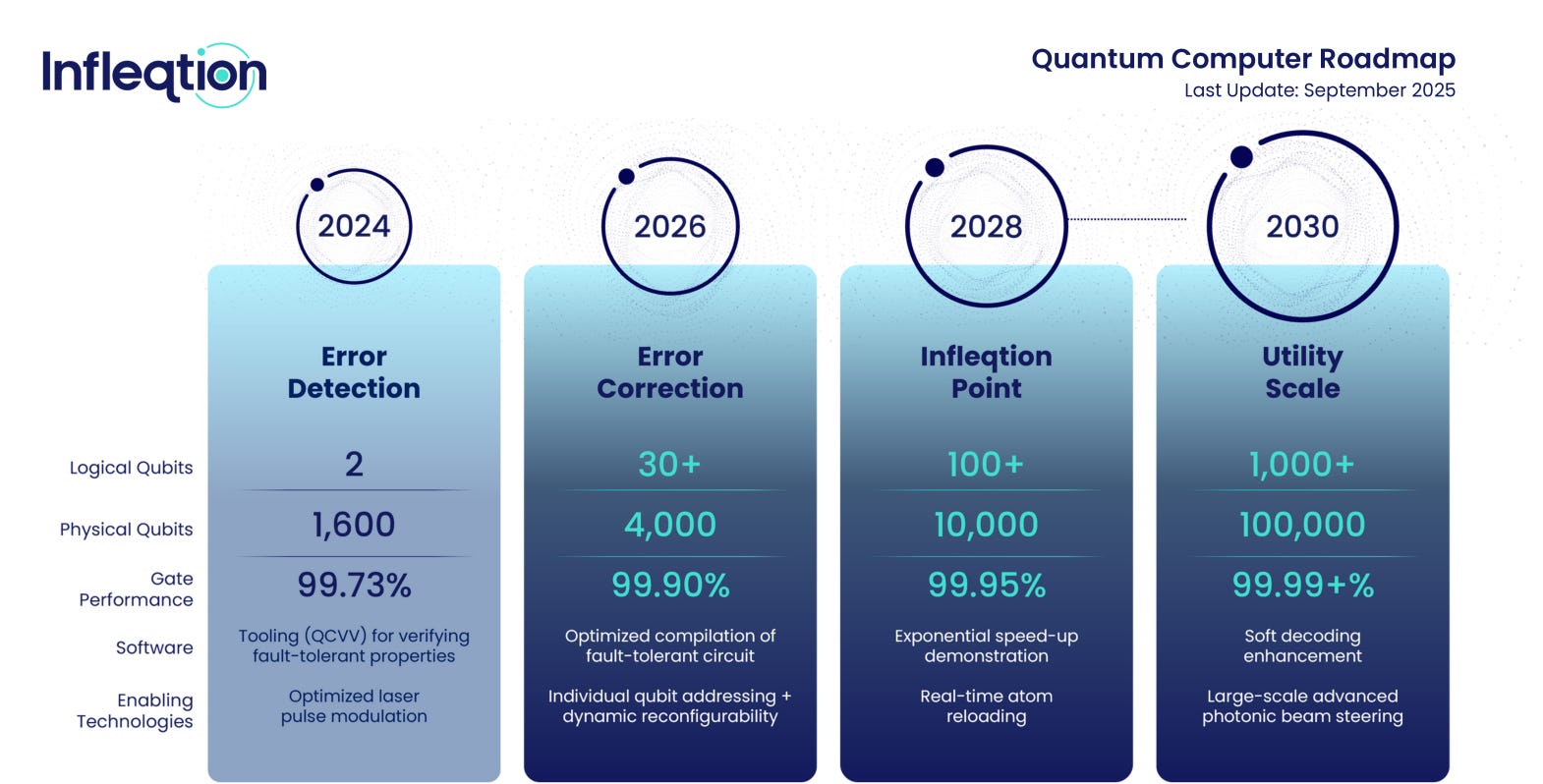
Infleqtion targets 30 logical qubits in 2026, more than 100 by 2028, and more than 1,000 in a full stack fault tolerant system by 2030. The 2028 figure is the one to watch, because it lines up with the executive order’s call for a research grade quantum computer inside a DOE national lab by 2028, and Infleqtion already works across that lab system. The White House declined to name companies, so this is positioning rather than a confirmed seat, but Infleqtion is plausibly in contention for exactly the machine the order describes. The company also expects 2028 to be when true quantum advantage starts to appear, with quantum machines beating classical ones in certain areas.
That roadmap is what justifies the large TAM number of $100 billion by 2035: simulating molecules for drug and materials discovery beyond the reach of classical machines, optimization across logistics and finance, and the cryptographic capability driving the entire Q-Day push. The standing caveat is that broadly useful fault tolerant quantum computing is still years out, and timelines across the industry have a habit of slipping. Infleqtion’s edge against that risk is that it doesn’t have to wait, because the sensing business funds the runway while it does.
Forced Buying and Russell inclusion
Infleqtion joins the Russell indexes at the 2026 reconstitution, effective after the close TODAY, June 26. That’s the moment every index fund tracking a Russell benchmark has to hold the new composition, so the mechanical buying concentrates into a single closing auction, one of the highest volume sessions of the year, because a very large pool of money is benchmarked to these indexes. The filing confirms Russell 3000 inclusion, and at a market cap near $3 billion Infleqtion sits in the small cap Russell 2000 band, the segment passive small cap money actually tracks.
Russell inclusion should introduce a new base of passive and benchmark aware institutional ownership. The exact amount of required buying is uncertain. Estimates put passive demand in the rough range of tens of millions of dollars to low hundreds, on the order of around 10% of Infleqtion’s current free float, but treat that as an estimate rather than a precise figure, since it depends on assumptions about float and fund tracking. The mechanism behind it is what makes it matter, Russell weights are set by float adjusted market cap, not total market cap, and Infleqtion has a wide gap between the two because legacy holders own roughly 70% of the company. The tradable float is therefore thin, and pushing mandatory buying through a thin float is the kind of setup that can move a price and help hold it, since passive funds tend to be longer duration holders rather than fast money. Inclusion also tends to lift average daily volume over the following year and pull in institutional owners, both of which can compress volatility over time.
What Could Break The Thesis
A thesis is only as honest as its risk section, so here is what I am actually watching.
Government procurement is slow, competitive, and lumpy. Awards slip, and demand signals are not the same as signed contracts.
The $100 million CHIPS LOI remains conditional, subject to diligence, final agreements, and milestones.
Project Farseer has not selected winners. The fit is excellent, but nothing is awarded yet, and the follow on production mechanism is a possibility, not a promise.
Roadmap timelines can slip, as they regularly do across the entire quantum industry.
Neutral atoms have major advantages, but no modality has conclusively won, and the field can still surprise.
Future dilution is a real risk for an early stage, cash burning company.
I still believe the opportunity outweighs these. But the bull case gets stronger, not weaker, when you can see the risks laid out plainly and decide for yourself.
How I actually hold this


This name is extremely volatile. I am not telling you it will 10x tomorrow, or even by 2028. I’m an 18 year old just entering college, which means time is my single greatest asset. I can hold through drawdowns that would shake out someone who needs the money in three years, and I can take risks I actually believe in. I believe in quantum, and Infleqtion is my bet.
We are at a genuine inflection point. Governments are flooding in faster than ever, policy is being written in real time, and companies are advancing more quickly than before as quantum advantage moves from theory towards a foreseeable goal. As Matt Kinsella put it, “quantum has gone from a question of IF to WHEN.” I wanted this article to connect many dots for you and really help you understand the scale this is going to and why I’m so bullish. I hope you can come back to this article one day after it all works out.
I’d appreciate it if you followed me on Substack and left any comments on what I should write next!
This is my own research and opinion, not investment advice, and I am not a financial advisor. Quantum is a high risk, early stage sector. Do your own diligence, size accordingly, and treat every roadmap target and every predicted contract award as a probability rather than a promise. Wherever I flagged something as unconfirmed or as my own speculation, that is exactly what it is, and you should keep those labels if you republish any of this.
Great analysis. Started buying during SPAC phase based not just on the tech, but mainly on what I see as excellent leadership (Matt and Pranav). One of my larger positions and I plan to hold to see it through.
Good work brother